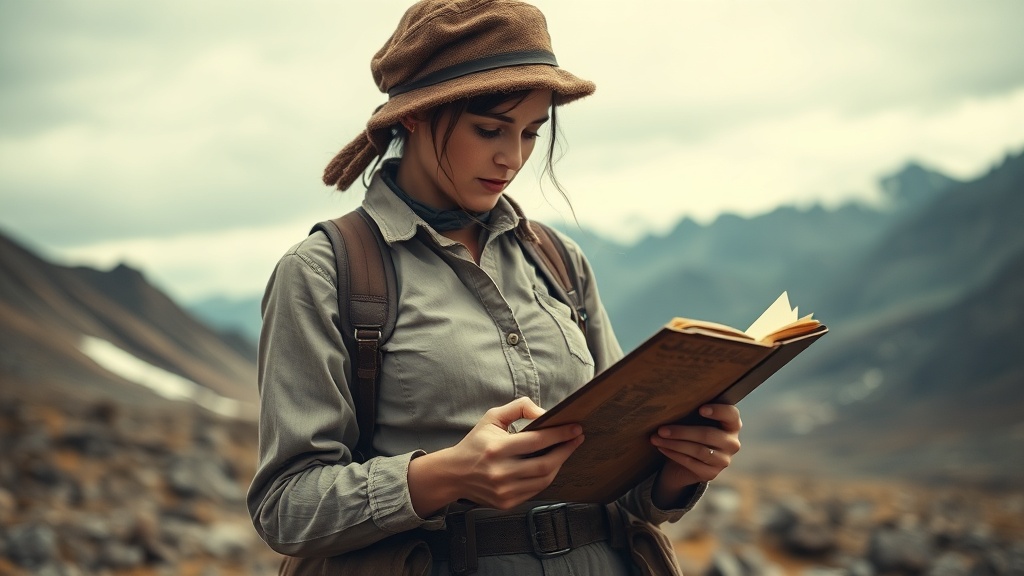
The Women Who Actually Explored: Before Solo Female Travel Was an Instagram Niche
International Women's Day is in three days, and my inbox is already full of "empowering female travel experiences" starting at $4,200 per person. IWD travel marketing is mostly greenwash — I'm going to set those aside.
Instead, I want to talk about women who actually did it. Not the curated Instagram version. The unglamorous, structurally disadvantaged, genuinely dangerous version — because that context matters for understanding what women traveling today are still navigating, even if the specific obstacles have changed.
I spent six years in supply chain work before I started this blog. I read a lot of historical shipping manifests. You start to notice who isn't on them.
Isabella Bird Didn't Have a Gear Sponsor
Isabella Bird published A Lady's Life in the Rocky Mountains in 1879. She'd already traveled Japan, Australia, and Hawaii by then — often alone, often on horseback, always writing. The Victorian medical establishment kept diagnosing her with a spinal condition that required bedrest. She treated it by riding 800 miles through Colorado.
The thing I keep coming back to: Bird had zero institutional support. She had to fight for the right to be elected to the Royal Geographical Society (she was admitted in 1892, then the Society voted to exclude women again the following year — women weren't fully admitted until 1913). Her travels were dismissed as "eccentric" or explained away as health cures.
She documented what she saw with the same rigor any male contemporary would have. She just had to also argue that she had the right to be there.
Modern parallel: From what I've observed working adjacent to travel media, women writing adventure content are more often slotted into the "lifestyle" category regardless of what they're actually covering — and have to do more work to be read as "serious" travel writers. I can't point you to a clean dataset on this. But I'd be surprised if you'd disagree based on your own reading habits.
Freya Stark Negotiated Access in Places Men Couldn't Enter
Freya Stark traveled through the Hadhramaut valley in Yemen in 1934, mapping routes that no Western cartographer had documented. She spoke fluent Arabic and Persian. She also negotiated entry into spaces — particularly women's quarters in villages — that were completely closed to male travelers.
This is the practical point most travel media skips over in the IWD content cycle: women travelers have access that male travelers don't. Stark used it as a genuine advantage. She gathered intelligence (literal wartime intelligence — she worked for the British Ministry of Information during WWII) that her male colleagues couldn't.
She was also hospitalised with measles and dysentery on more than one trip. She wrote about it plainly, without dramatizing it as "overcoming adversity." It was just logistics.
What this looks like today: Women traveling in parts of Southeast Asia, the Middle East, and Central and South Asia still navigate gender-specific access and gender-specific risks — sometimes simultaneously. The advantage isn't often discussed because it complicates the narrative. But it's real, and worth knowing.
Junko Tabei Summited Everest While Fighting for the Right to Try
In 1975, Junko Tabei became the first woman to summit Everest. She was also, at various points, told by the climbing establishment that:
- Women lacked the physical capacity for high-altitude mountaineering
- She was taking a spot that should go to a man
- Her team was essentially a PR stunt
Her response was to keep climbing. She went on to summit the highest peak on every continent (the Seven Summits) and founded the Himalayan Adventure Trust of Japan, which focused on environmental conservation in mountain regions.
The environmental work is often left out of the summary bio. It shouldn't be. Tabei was doing actual conservation infrastructure — organizing cleanup expeditions, training local guides, advocating for trail standards — while most of the mountaineering world was still arguing about whether women could do it at all.
Her expeditions were funded through a combination of her own income, contributions from Japanese women's groups, and modest corporate support — not the brand ambassadorships and sponsored gear pipelines that dominate expedition climbing today. The scale of institutional backing she worked with versus what she accomplished with it is the part that doesn't make the headline.
What the Pattern Actually Is
Here's what I took from logistics work: when you audit a system, you look for where friction is artificially introduced. Not natural friction — every supply chain has inefficiencies — but friction that exists specifically because of a process design choice that benefits someone else.
Women in travel have faced artificial friction at almost every level:
- Access to maps, navigation tools, and geographic information (historically gatekept by institutions that excluded women)
- Safety infrastructure designed for male travelers by default (travel safety data is still rarely disaggregated by gender in any systematic way)
- Financial access to travel credit, sponsorship, media coverage, and gear at male-coded price points
- Credibility friction — the constant need to justify expertise that male peers don't have to justify at the same rate
The women I've described didn't wait for that friction to be removed. They also didn't pretend it didn't exist — they documented it, worked around it, and where possible, dismantled it.
The Practical Part, Because That's What This Blog Is For
If you're a woman planning travel this spring, three things Bird, Stark, and Tabei would recognize immediately:
1. Your sources of friction are specific. Solo female travel safety isn't monolithic. The risks and access dynamics in Japan are not the same as Morocco, which are not the same as rural Appalachia. Generic "safety tips for women travelers" are largely useless. Find destination-specific communities — country-specific subreddits (r/solotravel and country-specific subs have active, unvarnished threads), organizations like Wild Women Expeditions and Worldpackers with community-sourced safety data, and women's travel groups on Discord and Facebook that skew more candid than polished travel publications. Know what your specific destination will cost before you commit to dates.
2. The "women's quarter" advantage is still real. Women traveling alone often get invited into homes, conversations, and local spaces that group tours and male travelers miss entirely. This isn't a feel-good observation — it's a genuine access differential that shapes what kind of travel experience you have. Plan for it. Leave room in your itinerary for unscheduled depth.
3. Gear defaults are still wrong. This is a logistics problem: most "standard" travel gear (backpacks, sleeping bags, trekking poles) is sized and specced for average male bodies. Women's-fit options with torso-length adjustments, sleeping bags with warmer temperature ratings for female metabolic rates, and appropriately sized poles exist — but you have to specifically seek them out rather than assuming a unisex option covers you. Osprey, REI Co-op, and Gossamer Gear have done better work here than most.
My Honest Take
I'm skeptical of IWD travel content that centers empowerment without centering specifics. "Women can travel the world!" is not information. It's a tagline.
What's actually useful: knowing that Isabella Bird was doing it in corsets in 1873, which tells you something about the relationship between equipment constraints and determination. Knowing that Freya Stark turned gendered access into a professional advantage, which is a useful reframe for how you approach trip planning. Knowing that Junko Tabei was doing conservation work that the mountaineering media largely ignored until it became convenient to include in her legacy — which tells you something about whose contributions get recorded.
The women who changed what travel looks like for everyone who came after them weren't waiting for the infrastructure to catch up. They built it while going.
That's the part worth celebrating.
Callie Vance is a former supply chain auditor who started EcoExplorer because she was tired of sustainable travel being marketed as either luxury or deprivation. She travels with a spreadsheet and a very low tolerance for vague claims.