The No-Bottle Water Protocol I Use on International Trips (So I Don’t Buy 3 Plastic Bottles a Day)

The No-Bottle Water Protocol I Use on International Trips (So I Don’t Buy 3 Plastic Bottles a Day)
Excerpt: A logistics-first safe-water protocol for international travel: when to trust tap, when to boil, when to disinfect, and when to walk away.
Category: Planning Guides
Tags: safe drinking water travel, refillable bottle, travelers diarrhea prevention, low-waste travel, travel planning
Meta Title: International Travel Water Safety: A No-Bottle Protocol That Actually Works
Meta Description: A field-tested travel water protocol using CDC and EPA guidance so you can reduce bottle waste without gambling on unsafe tap water.
If you want to get sidelined on day three of a trip, gamble on tap water because "it looked fine."
If you want to travel lighter, spend less, and avoid plastic bottle overload, run a system.
I spent years auditing supply chains. I treat drinking water the same way: verify inputs, control failure points, and don’t trust marketing labels over hard process.
This is the protocol I use when I’m in places where water safety is uncertain.
First, the non-negotiable rule
If local tap safety is unknown, I default to one of these only:
- Factory-sealed bottled water.
- Water I treated myself (boiled, correctly disinfected, or filtered with the right setup).
CDC Yellow Book 2026 is explicit here: in areas where tap may be unsafe, use factory-sealed bottled water or adequately disinfected water for drinking, brushing teeth, making ice, and food prep.
Translation: "I only drank it" is not enough. Ice, salad rinse, and toothbrushing water all count.
My 4-tier water decision tree
I run this in order, every destination.
Tier 1: Lowest friction, lowest risk
Use unopened, factory-sealed beverages or bottled water from a trusted source.
Yes, this can create plastic waste. It is still better than losing 48 hours to GI illness because you assumed a hotel faucet was fine.
Tier 2: Boil when you can control heat
CDC traveler guidance: full rolling boil for 1 minute; at elevations above 6,500 ft, boil for 3 minutes.
EPA emergency guidance also instructs extending boil time at elevation and gives 3 minutes above 5,000 ft. To keep this simple in the field, I use the conservative rule: if I’m at elevation, I run 3 minutes and move on.
Tier 3: Disinfect when boiling isn’t practical
If I can’t boil, I disinfect.
CDC notes disinfectants can kill most bacteria and viruses, but are less effective on resistant parasites (notably Cryptosporidium and Giardia). So this is not magic water. It’s conditional risk reduction.
EPA gives practical bleach dosing (for unscented household bleach):
- 1 gallon water: 8 drops (6% bleach) or 6 drops (8.25% bleach)
- Wait 30 minutes
- Water should have a slight chlorine smell
If there’s no smell, repeat dose and wait again.
Tier 4: Filter + treatment stack
CDC traveler guidance is blunt: most portable filters don’t remove viruses. Their page points to NSF 53/58-certified filters for parasite removal and reverse osmosis for broader removal.
My practical take:
- Basic squeeze filter alone: good for many backcountry parasite scenarios, weak for viruses
- Urban/travel uncertainty: use a layered approach (filter + chemical disinfection, or a purifier system rated for viruses)
If you don’t know exactly what your device removes, assume gaps.
Failure points travelers keep missing
These are the mistakes that break otherwise good plans:
- Brushing teeth with tap "just this once"
- Ice in "safe-looking" cocktails
- Fountain drinks mixed with local water
- Buying bottles that are resealed or questionably stored
- Using iodine despite contraindications (CDC warns against iodine disinfection in pregnancy, thyroid disease, or iodine sensitivity)
One sloppy exception can undo the rest of your protocol.
The low-waste setup I actually carry
I keep this compact:
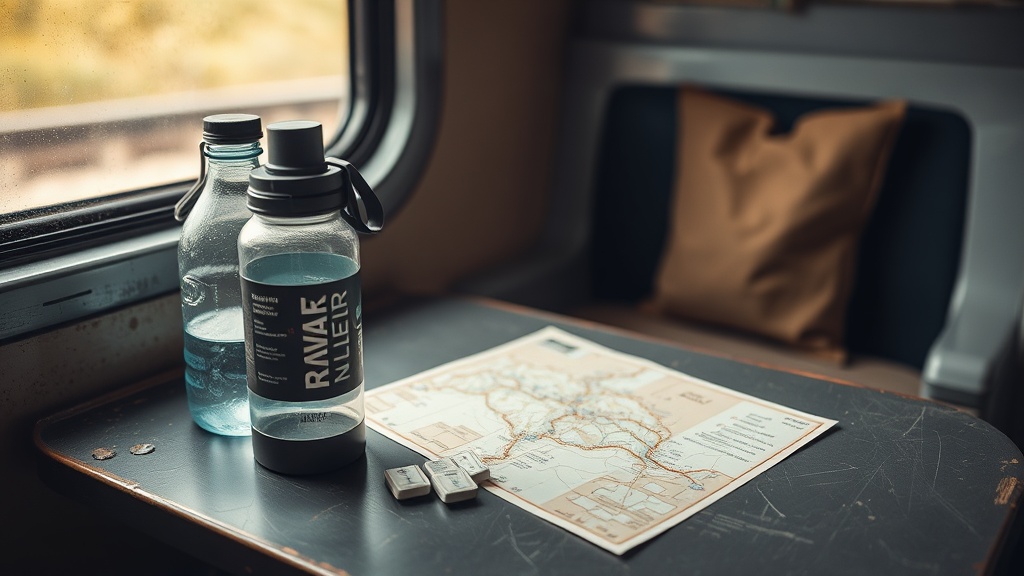
- 1 durable bottle (my battered 32 oz Tank)
- 1 backup collapsible bottle for treated-water staging
- Chlorine dioxide tablets or equivalent disinfectant
- Small prefilter (for sediment/cloudiness)
- Written dosing card in my wallet (so I don’t do mental math while tired)
This setup cuts random single-use bottle buys while keeping health risk management intact.
BS-meter: "Filtered by volcanic rock" labels
BS-meter: 8/10.
If a property sells a sustainability story but can’t explain treatment method, testing cadence, or what contaminants are covered, that’s branding, not operations.
Ask one question at check-in: "Is this water treated for microbes only, or also tested for chemical contaminants?"
If staff can’t answer, I treat water myself.
Bottom line
You don’t need perfect purity theater. You need a repeatable system with known limits.
- Unknown tap: don’t wing it
- Boil or disinfect correctly
- Understand what your filter does not remove
- Close the side doors (ice, teeth, fountain drinks)
That’s how you stay functional, reduce avoidable bottle waste, and keep the trip on track.
Sources
- CDC Yellow Book 2026, "Food and Water Precautions for Travelers" (reviewed/published April 23, 2025): https://www.cdc.gov/yellow-book/hcp/preparing-international-travelers/food-and-water-precautions-for-travelers.html
- CDC Travelers’ Health, "Avoid Contaminated Water During Travel" (last reviewed November 8, 2022): https://wwwnc.cdc.gov/travel/page/water-disinfection
- U.S. EPA, "Emergency Disinfection of Drinking Water" (last updated February 24, 2026): https://www.epa.gov/ground-water-and-drinking-water/emergency-disinfection-drinking-water