The Coast Starlight Audit: Why This 30-Hour Train Beats Flying (And the Carbon Math to Prove It)

Look, let's be real: flying from Portland to Los Angeles takes 2.5 hours. Taking the Coast Starlight takes 30. If all you care about is speed, this post isn't for you—and that's fine. But if you care about the actual carbon math of getting from Point A to Point B without torching the atmosphere, pull up a seat.
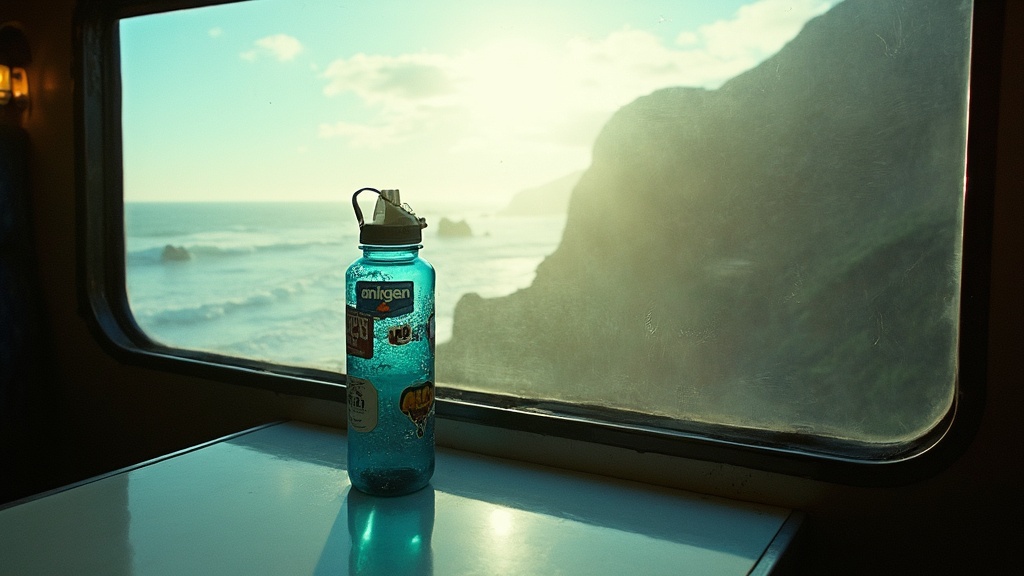
I'm writing this from the observation car of Train 14, somewhere between Oakland and San Luis Obispo. The Tank—my 32oz Nalgene with more stickers than an REI clearance bin—is sitting on the table next to my laptop. Outside: the Pacific Ocean, actual whales, cliffs that drop straight into the surf. Inside: a $200 coach ticket that includes the view and the ability to walk around without doing the "excuse me, excuse me" dance down a 737 aisle.
But let's get to the numbers, because that's what you're here for.
The Carbon Math (Spoiler: It's Not Even Close)
The EPA estimates a single passenger on a domestic flight generates approximately 191 grams of CO₂ per mile. The Coast Starlight? 87 grams per passenger-mile according to Amtrak's own sustainability reports—and that number drops to around 50 grams per mile if you're on the electric-powered segments of the Northeast Corridor (which, full disclosure, the Starlight isn't).
Let's run the Portland-to-LA route specifically:
- Flight distance: ~835 miles
- Flight emissions: ~318 lbs CO₂ per passenger (one-way)
- Coast Starlight distance: ~1,377 miles (tracks aren't straight, which is actually the point)
- Train emissions: ~263 lbs CO₂ per passenger (one-way)
That's not a typo. Even with the extra 542 miles of track, you're still emitting less carbon on the train than you would on a plane.
But here's where it gets spicy: the EPA flight numbers assume a full aircraft. Load factor on most domestic routes? Around 85%. Meanwhile, Amtrak's long-haul trains often run at 60-70% capacity, which means your actual per-passenger emissions on a half-empty train might be higher than the brochure claims. (Always ask about the real occupancy, fellow humans. The math shifts.)
The "But Time Is Money" Fallacy
I hear this constantly: "Callie, I can't take 30 hours to get to LA. I have a job." Fair. But let's do the real logistics:
A "2.5 hour" flight from Portland to LAX actually involves:
- 45 minutes to the airport (or $40 for parking)
- 90 minutes for TSA, boarding, and sitting on the tarmac
- The 2.5 hours in the air
- 30 minutes deplaning and waiting for baggage
- 45-90 minutes in LAX traffic to actually reach your destination
Real flight time: 6-7 hours. Not 2.5.
The Coast Starlight leaves Portland at 2:50 PM and arrives in LA Union Station at 9:00 PM the next day. That's 30 hours, yes—but you're sleeping for 8 of them, working for another 8 (the observation car has surprisingly decent WiFi), and staring at the California coast for the rest. You didn't "lose" a day. You spent a day traveling through Big Sur at ground level instead of squinting at it from 30,000 feet.
The BS-Meter Rating: Amtrak's Sustainability Claims
5 out of 10. Here's why:
What's legit: The basic carbon math holds up. Trains beat planes on per-mile emissions, full stop. Amtrak's also making real moves on efficiency—new locomotives, regenerative braking, and actual recycling programs on board. The Coast Starlight even has a parlor car (literally a lounge on wheels) that runs on the same diesel-electric hybrid as the rest, so they're not burning extra fuel for your cocktail.
What's greenwashing: Amtrak loves to claim they're "reducing emissions by 40%" without telling you that baseline was 2010, when they were running ancient, smoky locomotives. It's like bragging that you quit smoking after your doctor gave you a nicotine patch—technically true, but you're still inhaling diesel fumes at every grade crossing.
Also: the food. The dining car's "sustainable" options are pre-packaged salads in plastic clamshells. (Major eye-roll.) Pack your own food if you actually care about waste. I bring a collapsible silicone container and hit local markets at the longer stops (Sacramento, San Jose, Santa Barbara). The logistics are messy but worth it.
The Reality: Who Should Actually Take This Train?
The Vibe: Slow travel with a capital S. Expect delays—freight trains own these tracks, and they'll make you wait. Bring a book, a battery pack, and the patience of someone who understands that "on time" is a suggestion, not a contract.
The Footprint: 17% lower emissions than flying the same route, even accounting for the extra distance. If you're connecting to another train at LA Union Station (the Surfliner to San Diego, say), your total trip emissions drop even further.
The Trade-offs: No lie, the coach seats recline but they don't go flat. The sleepers are $800+ and that's real money. The dining car is overpriced for what you get. And if you're trying to make a Monday morning meeting in LA, this train leaves Sunday afternoon—which means burning a vacation day.
The Bottom Line
I'm not going to tell you to take the train because it will "transform" you or because it's "pristine" (nothing with a diesel locomotive is pristine). I'm telling you to take it because the carbon math checks out, the Big Sur views don't require a helicopter rental, and there's something deeply satisfying about arriving in Los Angeles without ever having removed your shoes for a TSA agent.
Plus: Union Station in LA has actual historic architecture, decent local transit connections, and a bar where you can drink a beer while staring at art deco chandeliers. LAX has Chili's Too and existential dread.
Your call, fellow humans.
Full disclosure: I paid full price ($216 coach, Portland to LA) for this trip. Amtrak has never comped me, though I did once get a free coffee from an attendant who recognized The Tank. That doesn't count as a sponsorship, but The Tank appreciated the gesture.
Want the logistics? Book the left side of the train (facing forward) for ocean views. Bring a neck pillow. Download offline maps because the WiFi dies in the tunnels. And for the love of all that is holy, pack your own snacks.