Greenwash Audit: The Pragmatic Sustainable Home Office Setup

Look, let's be real. We spend a significant amount of time tracking logistics, auditing supply chains, and staring at spreadsheets from the comfort of our own homes. While fieldwork is ideal, organizing complex data sets is often more efficient at a proper desk.
Right now, with spring cleaning in the air, the internet is flooded with "eco-chic" office makeovers. We are seeing bamboo keyboard trays shipped from across the globe and $1,000 ergonomic chairs marketing themselves as "ocean-friendly."
Vibe Check: Many of these products rely on greenwashed marketing rather than empirical sustainability. You don't need to buy newly manufactured gear (with the accompanying packaging and shipping footprint) to have a sustainable workspace.
Here is a pragmatic, spreadsheet-backed breakdown of how to set up an eco-friendly home office that protects both your posture and the planet, focusing on durability and local sourcing.
The Ergonomic Chair: Used Commercial vs. New "Eco"
The moment you start talking about upgrading your home office, advertisements appear for new chairs made from recycled water bottles.
The Math Doesn't Add Up: Manufacturing and shipping a brand new chair across the Pacific has a measurable carbon footprint, regardless of whether the mesh back contains recycled plastic. Furthermore, many of these ultra-light, eco-branded chairs lack the structural integrity for long-term use.
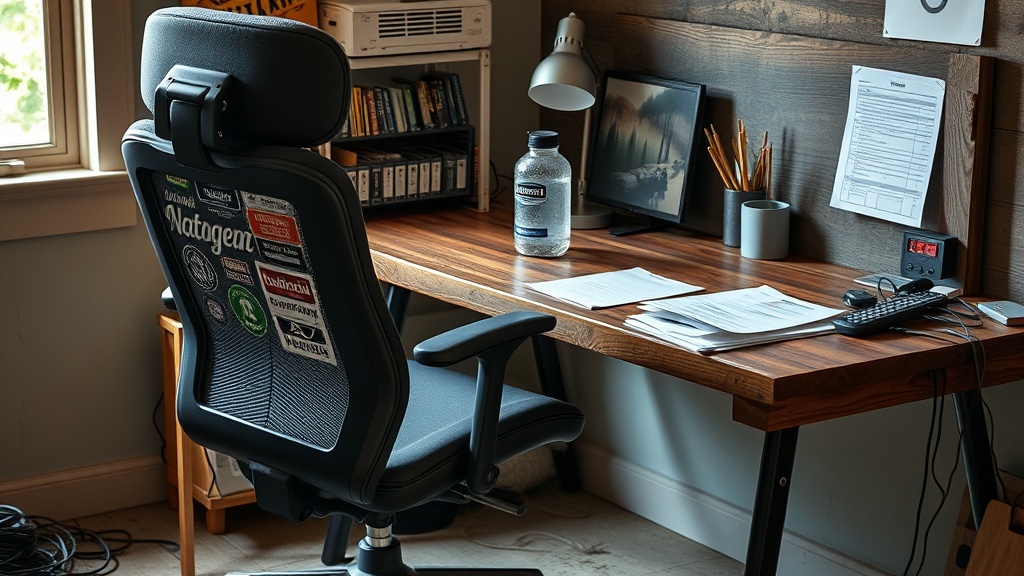
The Pragmatic Solution: Buy a refurbished, commercial-grade chair from a liquidator. Brands like Steelcase and Herman Miller are engineered for decades of heavy daily use. While their original 12-year warranties generally cover only the original purchaser and do not transfer to the used market, the sheer durability of their commercial lines makes them a reliable second-hand investment. You can find them at local office surplus stores for a fraction of their original cost. You get medically-backed ergonomics and you keep a heavy piece of furniture out of a landfill.
Your Desk Setup: Avoid the "Bamboo" Trap
Bamboo is theoretically a highly renewable resource. But if a bamboo sit-stand desk is harvested, processed, glued together with resins, and shipped 6,000 miles to your doorstep, the logistical carbon footprint often negates the material's environmental benefits.
Instead of buying a newly manufactured standing desk, look at what you can upcycle. Attaching a set of high-quality motorized legs to a locally sourced, reclaimed wood top or a solid-core door extends the life of existing materials. If you must buy new, prioritize companies that use transparent, localized supply chains and FSC-certified wood, even if it is just basic pine or oak.
The Energy Load: Monitor Placement and Lighting
Let's audit the measurable energy your home office consumes.
- Ditch the Powered Accessories: A smart-mug that keeps your coffee warm via Bluetooth draws continuous power. An insulated thermos does the exact same job with zero electricity.
- Strategic Lighting: Stop illuminating the entire room to read a spreadsheet. Position your desk perpendicular to a window to maximize natural light without creating screen glare. When the sun goes down, use a localized LED task lamp.
- The Power Strip Audit: Your monitors, chargers, and external drives pull phantom power all night. Get a basic power strip and physically switch it off when you clock out. Transparent energy bills are beautiful things.
Evaluating Office Supplies
I avoid individual, plastic-wrapped "eco-friendly" pens or recycled paper notebooks that carry a heavy premium.
The most sustainable office supplies are the ones you already own. Dig through your drawers and use up the mismatched pens from old conferences. When you finally run out, buy a single, high-quality refillable pen (like a fountain pen or a sturdy metal rollerball) and buy ink in glass bottles.
The Bottom Line
True sustainability is about buying less, buying used, and demanding gear that does not fall apart. An ergonomic, productive home office doesn't require a total spring refresh filled with newly manufactured green products. It requires a solid secondhand chair, a reliable power strip, and the realization that the best way to reduce your footprint is to simply opt out of the upgrade cycle.