Amtrak vs. Flying: The Real Carbon and Cost Math for Summer 2026

Look, let's be real—the moment you start talking about taking the train across the country, someone is going to chime in with, "But flying is so much cheaper!"
Is it? Really?
As we gear up for Summer 2026, I’ve been fielding a lot of questions from fellow dirty-boot travelers looking to avoid the impending chaos of peak-season airports while not actively contributing to the climate disaster. But before you book that ultra-low-cost flight, we need to do a serious audit. Because when you actually run the numbers—factoring in the carbon, the hidden fees, and the sheer logistical friction—the math doesn't add up the way the airlines want you to think it does.
Here is the pragmatic, spreadsheet-backed breakdown of Amtrak sleeper cars versus domestic flights.
The Carbon Math: No Marketing Fluff Required
Let’s start with the environmental cost. We already know that buying a "carbon-neutral" flight add-on is mostly BS. When you fly domestic, you’re looking at roughly 0.4 to 0.6 pounds of CO2 equivalent per passenger mile.
On an Amtrak train (especially along the electrified Northeast Corridor or newer diesel-electric routes out West), that number drops to around 0.1 pounds per passenger mile. That is an enormous difference. If your goal is to physically move your body across the continent with the least amount of atmospheric damage, rail is the clear winner. The math checks out.
The Hidden Costs of the "Cheap" Flight
This is where the financial argument for flying usually breaks down. Sure, that $79 cross-country ticket looks great on a booking site. But let's do a real logistical breakdown:
- The Baggage Tax: You want to bring more than a single personal item? Add $40-$80 each way.
- The Transit Tax: Ubers to and from the airport (which are almost always outside the city center) can easily run $50-$100 total.
- The Airport Survival Tax: The inevitable $18 mediocre sandwich and $6 bottle of water you have to buy because the TSA threw yours out.
Suddenly, that $79 flight is pushing $250.
Meanwhile, an Amtrak sleeper car ticket (like a Roomette) includes all your meals, coffee, and water. Your luggage? Included. And train stations drop you right in the middle of the city, meaning you can often take local transit to your final destination for under $3.
The Time Trade-off: Vibe Check
I'm not going to pretend that a 40-hour train ride is the same as a 4-hour flight. Travel involves trade-offs.
If you have a strict timeline, flying is sometimes the only logistical answer. But if you have the luxury of time, the train fundamentally shifts the "travel" part of your trip from a miserable chore to actual downtime. You get a bed, you get a desk to work at, and you don't have to deal with taking your shoes off for security theater.
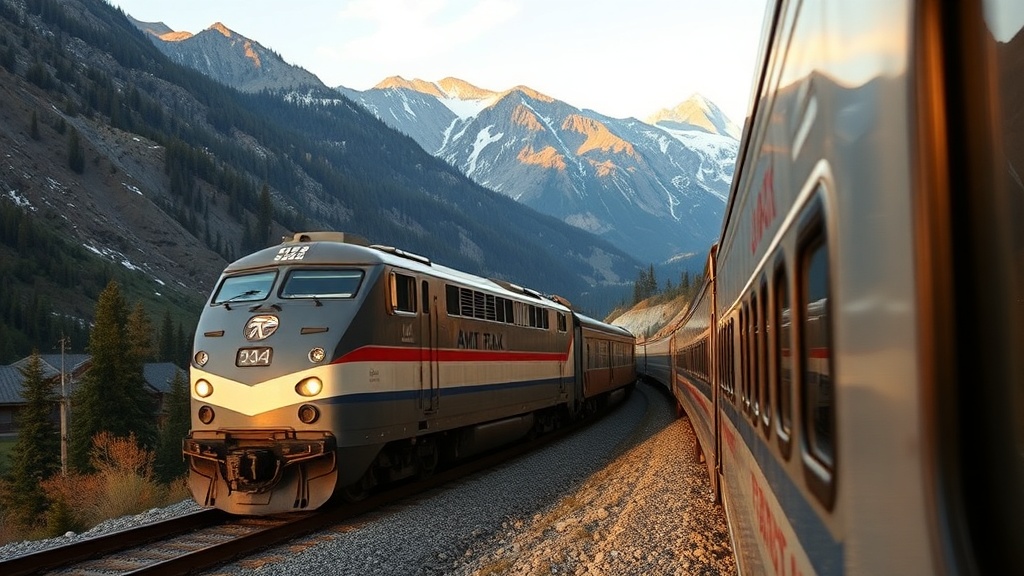
It’s forced decompression. I've spent hours working on my laptop while drinking decent coffee from my battered Nalgene as the Rockies roll by. It beats fighting for an armrest in a middle seat any day.
The Verdict
If you need to be across the country by tomorrow morning, fly. (But don't lie to yourself about the carbon impact).
If you are planning a summer trip and have the flexibility, an Amtrak sleeper car is the pragmatic middle ground. It forces you to slow down, it heavily reduces your carbon footprint, and when you factor in the meals, lodging, and luggage, it’s far more competitive than the budget airlines want you to realize.
Adventure more, footprint less. And skip the airport if you can.