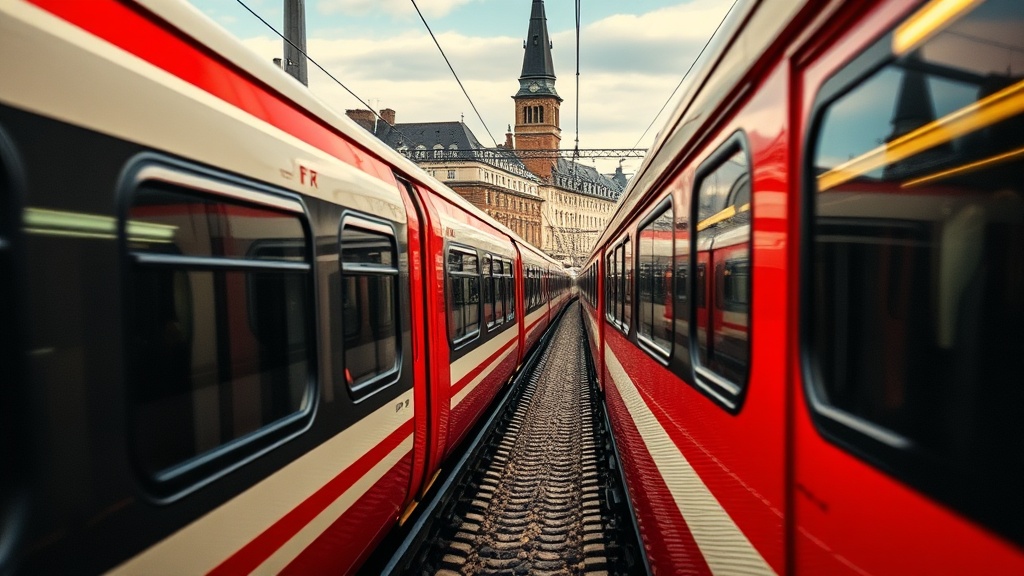
5 Ways to Use Public Transport for Your European Rail Adventure

Booking Interrail or Eurail Passes
Using Local Bus Networks for Remote Villages
Navigating City Transit with Digital Passes
Optimizing Travel with Night Trains
Relying on Bike-Sharing Programs in Urban Hubs
A traveler stands on a crowded platform at Berlin Hauptbahnhof, staring at a departure board that has just flashed a delay for the ICE train to Munich. They have a heavy backpack, a non-refundable hotel booking, and no clear way to reach their destination without a car. This is the reality of European travel: the infrastructure is superior to almost anywhere else in the world, but it requires a shift in how you plan your logistics. Relying on public transport isn't just a way to lower your carbon footprint; it is a way to reduce the friction of moving through multiple countries and cities. This guide breaks down five practical methods to navigate the European rail and transit networks effectively, ensuring you spend less time troubleshooting and more time exploring.
1. Optimize Your Booking with a Rail Pass or Point-to-Point Tickets
The first decision in any European rail journey is whether to invest in a rail pass, such as an Eurail or Interrail pass, or to buy individual point-to-point tickets. There is no "one size fits all" answer here; it depends entirely on your itinerary density and your tolerance for booking windows.
A rail pass is a high-utility tool if you are planning a high-frequency, multi-country trip. If you are moving from Paris to Amsterdam, then to Berlin, and finally to Prague, a pass offers the flexibility to change your plans on a whim. However, the "hidden cost" of a pass is the mandatory seat reservation. In countries like France (SNCF) and Italy (Trenitalia), high-speed trains often require a paid reservation even if you have a pass. If you don't book these in advance, you might find yourself with a valid ticket but no seat, or worse, no way onto the train at all.
If your trip is more linear—for example, traveling only within Germany or only within Spain—buying point-to-point tickets via official national carrier websites is usually more cost-effective. For instance, using the Deutsche Bahn (DB) website to book Sparpreis (saver) fares can save you significant money if you book at least two months out. Avoid third-party "aggregator" sites that charge extra service fees; go directly to the source to ensure you are getting the actual price and the most reliable real-time data.
When to choose a pass:
- You are crossing multiple borders in a short period.
- Your itinerary is fluid and you want to decide your next stop 24 hours in advance.
- You are traveling on a budget and can leverage "pass holder" discounts on regional transport.
When to choose point-to-point:
- You are staying in one specific region (e.g., Tuscany or Bavaria).
- You are traveling on a strict, predetermined schedule.
- You want to avoid the hassle of booking mandatory seat reservations for every leg.
2. Use Local Transit Apps to Navigate the "Last Mile"
Getting from a major hub like London St Pancras to the city center is easy. Getting from the train station to a remote trailhead or a small village in the Swiss Alps is where the logistics fail. The "last mile" is the most difficult part of sustainable travel, and it is often where travelers abandon public transport for a taxi or a rental car.
To avoid this, you must download and master the local transit apps before you arrive. Do not rely solely on Google Maps; while it is excellent for general directions, it often lacks the granular, real-time data found in localized apps. For example, in many European cities, the Citymapper app provides much more accurate data regarding platform changes, exit numbers, and real-time bus arrivals than global competitors.
In Germany, the DB Navigator app is essential not just for long-distance trains, but for connecting to regional buses and trams. In the UK, the Trainline app is a standard, but for local London travel, the TfL (Transport for London) website provides the most accurate data for the Underground and buses. If you are traveling in the Alpine regions, the SBB Mobile app for Switzerland is a powerhouse; it integrates trains, postal buses (PostBus), and even cable cars, allowing you to plan a journey from a major city all the way to a remote mountain hut.
Pro-tip: Always check for "Local Transport Authority" apps. If you are in Lisbon, use the Carris app; if you are in Berlin, use the VBB app. These will give you the most accurate information on strikes, maintenance, or service changes that can derail your day.
3. Leverage Regional and Local Rail Networks for Low-Cost Travel
High-speed rail is the fastest way to move, but it is also the most expensive. If your budget is tight, you should pivot your strategy toward regional rail networks. These trains move slower, but they are significantly cheaper and often provide a much more authentic view of the landscape.
In Italy, the Regionale trains are a lifesaver for budget travelers. While you won't get the luxury of the Frecciarossa high-speed service, the price difference is massive. These trains also don't require seat reservations, meaning you can hop on and off with much more flexibility. Similarly, in France, the TER (Transport Express Régional) networks allow you to explore regions like Provence or Brittany without the high cost of the TGV.
If you are traveling in Central Europe, look into the ÖBB (Austrian Federal Railways). They offer excellent regional connections that are often more reliable and affordable than high-speed alternatives. Using these networks also helps distribute tourism revenue more broadly across a country, rather than concentrating it solely in major metropolitan hubs. This is a practical way to practice the principles of protecting landscapes by reducing the pressure on high-traffic, high-speed corridors and supporting the infrastructure of smaller communities.
4. Master the Art of the "Night Train" to Save on Accommodation
One of the most efficient ways to combine transport and lodging is the European night train. This is not just a way to travel; it is a logistics hack that saves you the cost of a hotel night and maximizes your daylight hours for exploration.
The Nightjet service by ÖBB is currently the gold standard for night trains in Europe. They run routes from cities like Vienna to Venice, or Berlin to Innsbruck. When booking, you have several tiers of service: a seat (not recommended if you want actual sleep), a couchette (bunks in a compartment with 4-6 people), or a sleeper cabin (private or shared with 1-2 people, often with a sink or even a small shower).
To make this work, you must book well in advance. Sleeper cabins on popular routes sell out weeks, sometimes months, before departure. If you are on a budget, the couchette is the best middle ground—it provides a bed and a sense of security without the premium price of a full sleeper cabin. To ensure a smooth experience, pack a lightweight sleep mask, earplppers, and a small power bank. Even though many modern night trains have power outlets, they can be unreliable or located in awkward spots in the compartment.
By using night trains, you are also reducing the carbon intensity of your trip. A single sleeper train can move hundreds of people across a continent with a fraction of the emissions of a short-haul flight or a fleet of individual cars. It is a high-efficiency, low-impact way to move through the European landscape.
5. Understand Ticketing Zones and Validation Rules
The quickest way to ruin a trip is to receive a heavy fine from a ticket inspector because you didn't understand the local rules. European transit systems are highly segmented into zones, and a ticket that works in one area may be completely invalid in another.
In cities like London, Paris, or Berlin, the transit system is divided into concentric circles or specific zones. If you buy a ticket for Zone 1 and 2, but your journey takes you into Zone 3, you are technically traveling without a valid ticket. Always check the zone map before you tap in or purchase a ticket. In many cities, you can use contactless payment (Apple Pay, Google Pay, or a physical credit card) on buses and subways, which automatically calculates the cheapest fare for you. This is often the most foolproof method for travelers.
Crucially, you must understand the concept of validation. In many European cities—particularly in Germany, Italy, and Austria—buying a ticket is only the first step. You must physically "validate" or "stamp" your paper ticket in a small machine (usually yellow or red) located on the platform or inside the bus/tram before you start your journey. If an inspector catches you with a purchased but unvalidated ticket, it is treated the same as having no ticket at all, and the fines are often steep and non-negotiable.
Before you set off, do a quick audit of your transit plan:
- Does my ticket cover all the zones I will pass through?
- Do I need to physically stamp this ticket before boarding?
- Is there a digital version of this ticket, or do I need a physical copy?